Showing posts with label Della. Show all posts

16 June 2012

"Let me 'splain..."

"No, there is too much... Let me sum up."

I think Inigo Montoya had the right idea. Since my last recap we did a coverage on the island of Antigua, cranked out a bunch of work in Lima, and then I headed to the States for Della's wedding and a little bit of time with friends and family. I've been back in Lima for less than a week and we head out again in the wee hours of the morning for about 22 hours of travel to Suriname, where I will be for a month. We'll come back and immediately jump in to several other projects and coverages. This summer (winter- depending on which side of the line I'm on which day) looks like it will be flying by!

Please be in prayer for those of us traveling to Suriname. Health is a big issue for me, all this running around and changing climate has been rough on my immune system, so please pray for some superhuman immunity! Also, I appreciate extra prayer for this trip as, in addition to my regular media duties, I will be involved with childcare...in the Amazon. :-/

In lieu of more detailed descriptions, here are a few photos from recent adventures:


Making some important calls from Antigua.

Sunset over Antigua

Prayer time in Antigua

Steel drum band in Antigua
Church in Antigua
On the way to and from Antigua we flew through Miami. First Wendy's spicy chicken sandwich in a year!

With my favorite prayer warrior, Jeremy!

I might have eaten a little bit of Chickfila in the US. It was awesome.


So good to see Carolyn after more than a year!!!
The Gator Nation IS everywhere!

Cracker Barrel!

Helping Della get ready

Me and Dells. It was a beautiful day!


Wedding party

The 386 (+) crew

Cha-cha slide time. :-) 

12 March 2012

Paraguay! Sugoi!

So... where was I? Paraguay? I should have written about it as soon as I returned. But you know how it is, at first you're playing catch up from traveling and are too tired, then you get back into the regular swing of work and forget. But yes, it was a great trip! I loved getting to know the very special family that we worked with there. We're working on a story about their autistic son Steven and the miracles God has worked in his life to bring him to a point where he is able to take the Gospel to Japan. He is such an impressive young man and a true testament to the dedication of his parents and the power of prayer.

This is Steven. Join me in praying for him while he serves in Japan!
I can't wait for the story to run!  God has done so much to weave all the details together that I can only imagine what else He is going to do in and through Steven and his story. I'd love to tell you all about it, but I don't want to spoil the story, so I'll just share a bit about the rest of the trip.

Port at Asuncion.
During this coverage we were in Asuncion, Paraguay, a small city in the middle of the South American continent. The weather felt like home: hot and humid. One afternoon it even poured rain and lightninged! (<--Wow that word looks really weird written out...)

RAIN!
What do you know about Paraguay? If you're like me...not much. I had to do some research, but thanks to all-knowing Wikipedia and my handy-dandy Insight Guide to South America I was able to fill in some gaps in my knowledge. So here is my condensed "highlights only" version. (And yes, the highlights are kind of long so skip down about 5 paragraphs if you don't want to learn some crazy things about Paraguay.) :

Paraguay is a landlocked country in South America sometimes called the "Heart of America" because of its location on the continent. Asuncion, the capitol, was founded in 1537, by Spanish conquistadors who had left the settlement of Buenos Aires, Argentina to go a'conquering up the Paraguay River. After battles with natives and food supply issues, the remaining settlers from B.A. evacuated to the safer and more lush outpost in Asuncion as well, and it then became the hub for exploration of the interior portions of the continent.

Me in front of the Presidential Palace
On May 14, 1811 Paraguay declared independence from the Spanish crown. Shortly thereafter, one of the new rulers, a civilian lawyer, José Francia, seized power (and you thought that reputation lawyers have was a recent one...) and in 1816 Congress named him "Supreme and Perpetual Dictator of Paraguay", or "el Supremo," for life (almost as impressive as Kim Il-Sung, the "Eternal President" of North Korea.) Worried about being annexed by Argentina or Brazil,  Francia closed the borders and didn't allow anyone in or out of the country for 24 years. He also banned Spaniards from marrying each other, decreed all dogs in the country killed and that no one could look at him in the streets, set up a secret police, kept a ledger of all the women he slept with, uprooted all the shrubs and trees along his riding route so no one could ambush him, and ordered executions of detractors carried out with a bayonet to save bullets. His iron-fisted rule left the country with accumulated wealth in the treasury, but also with a tradition of autocratic rule that would last almost uninterrupted until 1989. At his death, no Paraguayan priest was willing to say a mass, and a priest had to be imported from Argentina.

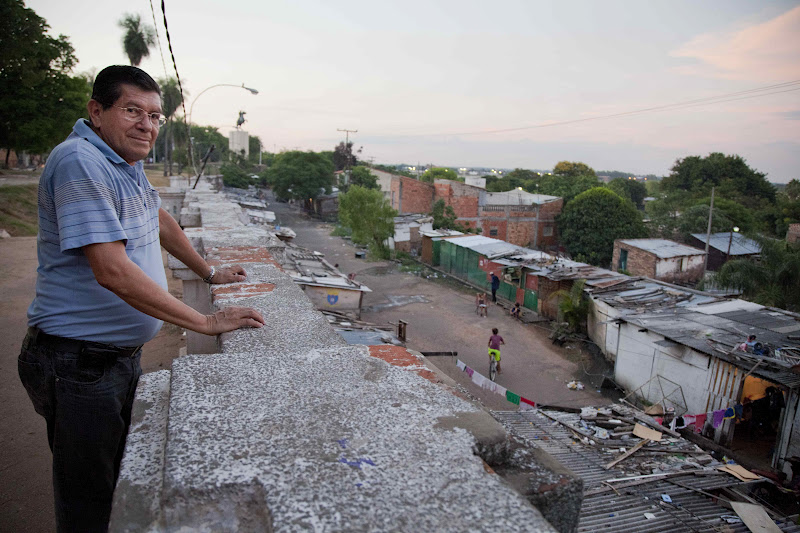
Our taxi guide looking over into the poor neighborhood behind the government buildings.  I walked over to take a picture and he decided he needed to come protect me. 
Francia's nephew, Carlos Antonio Lopez, was appointed to the leadership of the country following his uncle's death. Much like his uncle, everything was fine and dandy for the first few years until Lopez decided to go into the family business of dictatoring and took all the power. Fortunately he didn't rule with the same despotic tendencies as his uncle. Unfortunately, his son and successor, Francisco Solano Lopez, did. He made rash decisions that embroiled Paraguay in the Triple Alliance war with Brazil, Argentina, and Uruguay. In a cholera ravaged country, Solano Lopez ordered hundreds of executions and was eventually killed during the war either from injuries received in battle or by one of his own officers, depending on who you listen to. Regardless his dying words were "I die with my country" which was almost literally true. After the war,  half the estimated population of 525,000 were dead. Only 29,000 adult males survived. Paraguay was rebuilt mostly by women who resigned themselves to a polygamous society while the Catholic church pretended not to notice.

Poor neighborhood in Asuncion.
Between the fall of Solano Lopez in 1870 and the bloody Chaco War with Bolivia in 1932, Paraguay changed presidents 32 times, endured 2 presidential assassinations, 6 coups d'état, 2 successful revolutions, and 8 attempted revolutions. Paraguay won the Chaco War but the male population was once again devastated. A series of dictators ruled from then until 1954 when the son of a German brewer, Alfredo Stroessner, seized power in a coup d'état and ruled strictly for 35 years. He declared a "state of siege" soon after taking power so that he could suspend constitutional freedoms, and it was renewed every 90 days for the entire time he was in office (justified as a necessary step to protect against Communists), except when it was lifted for "elections." His regime was blamed for torture, kidnappings, and corruption and provided a haven for fleeing Nazis and narcotics smugglers, and in 1974 the country was accused by the UN of slavery and genocide because of their treatment of the Aché tribe of eastern Paraguay. The US maintained relations with Stroessner during the Cold War era because of his staunch anti-Communist stance, but the Carter and Reagan administrations began boycotting the country because of the human rights abuses. Although he did oversee several large hydroelectric and infrastructure programs that brought increased prosperity to the country, he was eventually ousted in a coup d'état by his closest confident, his daughter-in-law's father, General Andrés Rodriguez, in 1989. Stroessner was exiled to Brazil, and Rodriguez was officially elected president of Paraguay.

Some unflattering political graffiti by the presidential palace.
Rodriguez ended the state of emergency and most of Stroessner's repressive measures, allowed freedom of the press and oversaw a gradual transition to genuine democracy which included signing a new constitution that limited the president to a single 5-year term. There have been continuing issues, including an attempted coup by a general in 1996, but democracy seems to have a foothold in the country which elected a center-left president in 2008 after 60 years of continuous rule by a single conservative political party.

A little overwhelmed by that military-political history? Yeah, me too. So here's some other random info about Paraguay. The country is officially bilingual, speaking Spanish and Guarani, with only a very small portion of the population that speaks only Spanish. In rural areas it is more common for people to speak only Guarani. Many also speak Jopara, a type of Guarani mixed with Spanish. Guarani has a bunch of folk proverbs and jokes that give it a unique flair (and make less sense translated, but if you speak Spanish you can learn some here). Many ruins of Jesuit missions can be found across the country from their period of work in Paraguay from 1587-1767. The Chaco, the desolate, arid, and sparsely-populated region of the country, has attracted unusual immigrant communities for generations. The best known are the Mennonites who began arriving in 1927 and mostly speak German. Despite being a small minority they produce most of Paraguay's dairy products. More bizarrely, Friedrich Nietzsche's sister, Elisabeth, and her husband attempted to found a pure Aryan colony in 1886 but could not overcome the extreme living conditions of the Chaco.

Other ethnic groups have created small cultural pockets in Paraguay and manage to retain their language and culture. This played an important part in the story that is being done about Steven, since he was able to study the Japanese language and be discipled by a Japanese pastor and assist in the Japanese church, all in the heart of South America! Attending a bilingual church service isn't anything new to me, but attended one in Spanish and Japanese certainly was a new experience! The mix of cultures was remarkable. I had a great time watching the adorable kids play and using the few Japanese phrases I learned during our trip to Japan years ago. I never thought those would come in handy on a trip to Paraguay. Steven taught me a new word, "sugoi" which means "great" in Japanese. It's making my list of new favorite phrases. :-)


My favorite thing in Paraguay (aside from the wonderful people we met and the weather) was the handcrafts. They had so much neat stuff! And I definitely did my bit to help the Paraguayan economy by bringing home lots of souvenirs, especially the exquisite colorful lace pieces.

Handcrafted Nanduti lace. 

My new hand-tooled leather Bible cover.
Me with Steven and Cema.
Praying for Steven during his commissioning.

There was lots of awesomeness that happened during the few days we were able to be with Steven and his family, but one of the most exciting things had nothing to do with the story, Paraguay, etc. Nope. On February 18th my wonderful friend Della got engaged!


When we were silly freshmen in high school talking about our future husbands and getting married and all that fun stuff, never once did I imagine that I'd be staying up until the wee hours of the night in a hotel room in Paraguay to get to talk to her on the phone and hear about the proposal all these years later. Thanks to her sweet fiancé (so weird to say that...my best friend has a fiancé...woah!) he had kept me in the loop on the planning and had even let me be involved with arranging part of the proposal day.  It kills me to be so far away during these exciting life moments and the wedding planning, etc. but I am so thrilled that I'll at least be able to travel back to the states to be Della's maid of honor. I can't wait!
As Steven would say, "Sugoi!"


10 February 2011

Risky Business

Groundhog Day was last week and apparently Phil has decided it’ll be an early spring.  I don’t think Virginia got the message because it snowed again last night. Not much, just a thin dusting and I bet it’ll be mostly gone by lunch. Normally I’m not all that concerned about when spring is supposed to begin because in Florida it’s really all the same.  But here, in the frozen north, spring can’t come soon enough!  How is Virginia, you ask? Cold. Virginia is cold.  And often wet.  And so far, I’m not impressed.  But Virginia still has 43 days to make it up to me.  We’ll see.

 This was from the last blizzard, and not Virginia, but it made me laugh.

A couple weeks ago was an important anniversary: the 25th commemoration of the day the world was graced with Della Turner’s presence.  I think she and her awesomeness deserve a shout-out. 

She’s pretty stellar.

  It was also the 25th anniversary of the Challenger disaster, so as I read the text of Reagan’s speech that day, this portion stood out:

“I know it is hard to understand, but sometimes painful things like this happen. It's all part of the process of exploration and discovery. It's all part of taking a chance and expanding man's horizons. The future doesn't belong to the fainthearted; it belongs to the brave.” 

Most of us will never have the opportunity to go to space.  Most of us will never risk our lives mapping uncharted regions of the planet, or climbing an untouched mountain.  We won’t have a hand in expanding man’s physical horizons. But we will all have the option of expanding our own horizons, of taking a risk.  Yet, when those challenges arise, many of us will walk away. We let the fear of change, potential loss, failure, or even death dissuade us from the venture.  As Reagan explained, when you take risks, sometimes painful things happen.  That’s true.  If you strap yourself to 1.6 million pounds of propellant and try to launch yourself into orbit, there’s a chance you’ll lose your life in the process. But here’s the larger truth: painful things happen. Period. Painful things happen to people living quiet simple lives in suburban USA just the same as they happen to astronauts exploring space…or missionaries taking the Gospel to a closed and hostile country.  No one is immune.  Cancer, car accidents, natural disasters… even terrorist attacks: they can happen any time, anywhere.  Yes there are certain inherent risks to everything we do,  but usually what we allow to create fear and keep us from acting are the perceived risks.

That becomes a problem when it comes to Christianity.  In America we don’t sense a great deal of risk attached to following Christ because it does not necessarily cost us much. We have this idea that God wants to keep us safe and comfortable, but David Platt puts it this way in Radical (Great book. Read it. Now!): 

“We say things such as, ‘The safest place to be is in the center of God’s will.’ We think, if it’s dangerous, God must not be in it. If it’s risky, if it’s unsafe, if it’s costly, it must not be God’s will. But what if these factors are actually the criteria by which we determine something is God’s will? What if we began to look at the design of God as the most dangerous option before us? What if the center of God’s will is in reality the most unsafe place for us to be?”

Mark Batterson hits the nail on the head when he asks, “When did we start believing that God wants to send us to safe places to do easy things?” That’s not what we see modeled in the New Testament. As one of our instructors here in training keeps pointing out, the most normal place for Christians to be in the New Testament is in prison. And in many places around the world that is still the case. Following Christ is risky.  It always has been, it always will be.  And I’d go as far to say that it always should be, because Christianity that costs nothing produces the same. Nothing. And we KNOW that is not God’s will.  Refusing to take risks when God has called you to them means you are actually taking a much greater risk: being disobedient to Christ.  You are also risking missing out on what God is doing and missing out on His blessings. “We all want adventure, faith, miracles, and a deep knowledge of Christ, but you can’t have those things without letting go of safety, security, comfort, and control. You have to choose between safety and bravery. The bottom line is this: God’s will in a fallen world is dangerous. (Batterson)”

So yes, following Christ can be dangerous, but as we’ve already established, being alive is dangerous.  So doesn’t it make sense to go ahead and spend your life risking it all for the cause of the Gospel?

I’m sure I’ll ramble on more on this topic at a later date because it gets me fired up, so let's just call this "Part 1."  I leave you with an entry from one of my favorite books My Utmost for His Highest. (I love me some Oswald Chambers. And check it out, they have it in Spanish!) :


“Supposing God tells you to do something which is an enormous test to your common sense, what are you going to do? Hang back? If you get into the habit of doing a thing in the physical domain, you will do it every time until you break the habit determinedly; and the same is true spiritually. Again and again you will get up to what Jesus Christ wants, and every time you will turn back when it comes to the point, until you abandon resolutely. ‘Yes but- supposing I do obey God in this matter, what about…?’ ‘Yes I will obey God if He will let me use my common sense, but don’t ask me to take a step in the dark.’

            Jesus Christ demands of the man who trusts Him the same reckless sporting spirit that the natural man exhibits. If a man is going to do anything worthwhile, there are times when he has to risk everything on his leap, and in the spiritual domain Jesus Christ demands that you risk everything you hold by common sense and leap into what He says, and immediately you do, you find that what He says fits on as solidly as common sense.

 At the bar of common sense Jesus Christ’s statements may seem mad; but bring them to the bar of faith, and you begin to find with awestruck spirit that they are the words of God. Trust entirely in God, and when He brings you to the venture, see that you take it. We act like pagans in a crisis, only one out of a crowd is daring enough to bank his faith on the character of God.”